
Democracy Under Siege: Why “Giving Up is Unforgivable”
A Conversation with Joyce Vance


by Pat Rosa and Freda Zeh Rosen
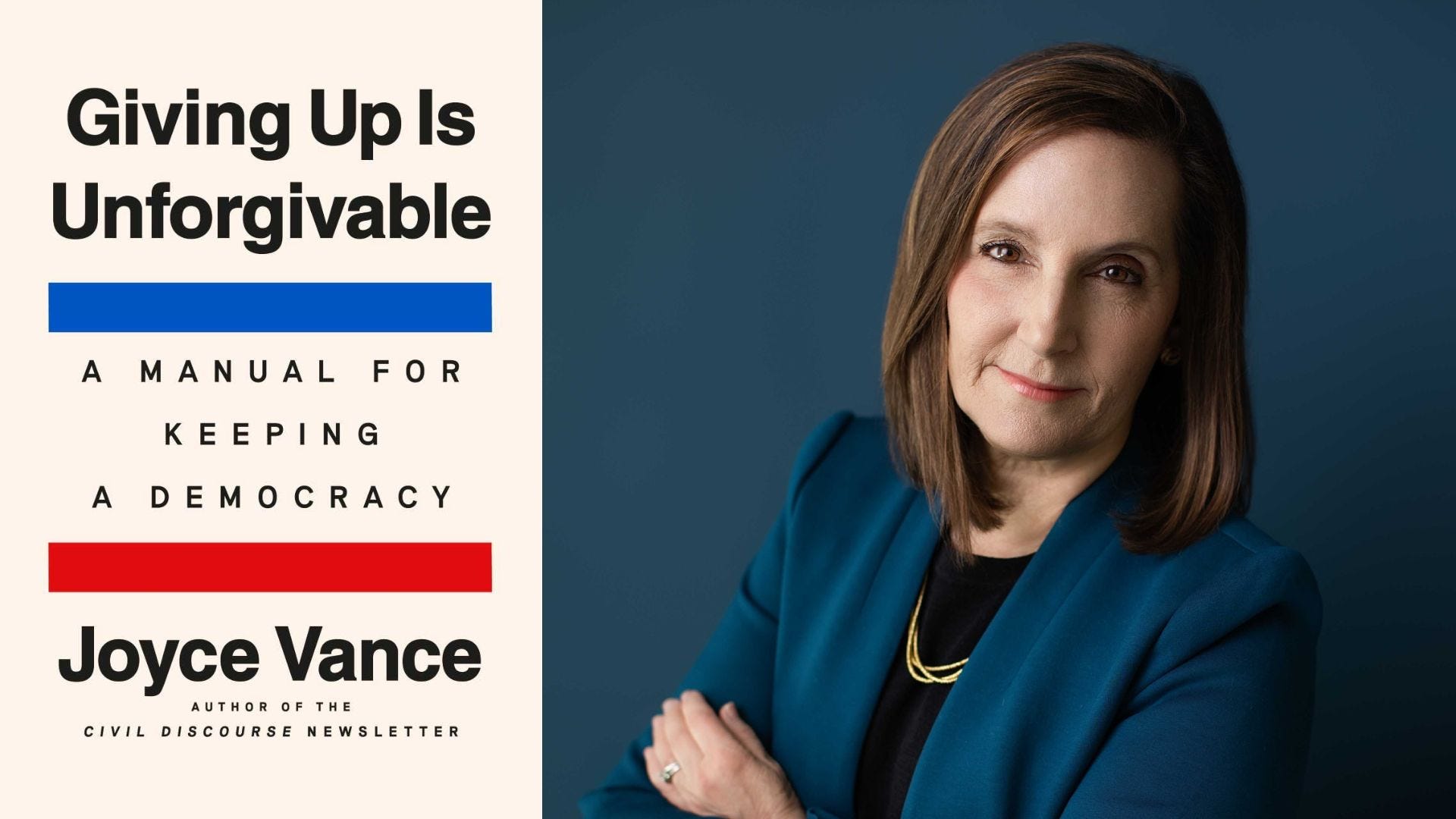
Recently, In the Know Live hosted Joyce Vance, former US Attorney for the Northern District of Alabama and one of our nation’s most respected voices on criminal justice and the rule of law. Joyce discussed her latest book, Giving Up is Unforgivable: A Manual for Keeping a Democracy, and addressed the urgent challenges facing American democracy today. Joyce served as US Attorney from 2009 to 2017 under President Obama, is now a distinguished professor at the University of Alabama School of Law, and a legal analyst for M,S Now. She publishes her political blog, Civil Discourse, on Substack, where she also co-hosts the popular podcasts Cafe Insider with Preet Bharara and Sisters-in-Law.
Here are some of the major themes from the interview:
Why giving up is not an option: Joyce explained that her book was born from a troubling moment after the 2024 election when many activists expressed exhaustion and a desire to disengage. She became “extremely frightened” by conversations with people saying they had done everything possible during the campaign and couldn’t do any more. Joyce recognized that without public opposition and citizens stacking up against authoritarianism, democracy would be in grave danger. She emphasized that if we’re working to hold on to democracy and our rights, we have tremendous power—citing examples like the Epstein file release, which happened because Americans refused to give up.
Understanding due process: Due process is perhaps the most critical legal concept Americans need to understand right now. The Fifth Amendment’s guarantee that no one can be deprived of life, liberty, or property without due process of law is fundamental to American democracy. As Joyce noted, Americans are becoming increasingly educated on these issues—protesters are now holding signs that say, “due process,” demonstrating that you don’t need to be a lawyer to understand what’s important about democracy. She emphasized that due process is a right afforded to all individuals in our country, not only citizens, and the recent ICE raids clearly demonstrate the importance of this principle.
The weaponization of the Justice Department: What’s happening at the Department of Justice was described by Joyce as “traumatic” and “utterly devastating.” Since Watergate, there has been a firm separation between the Justice Department and the White House. Presidents can set policy priorities, but they should never meddle in individual cases or decide who gets prosecuted based on personal vendettas. When decisions are made based on a president’s desire for revenge rather than law and facts, “you no longer have a functional justice system. You start to look like a banana republic.” Joyce noted the irony in Minneapolis, where prosecutors working on actual fraud cases were forced to resign while the administration pursued politically motivated investigations.
Threats to free and fair elections: Addressing concerns about the 2026 midterm elections, Joyce explained that while Trump probably cannot simply cancel elections outright due to their decentralized nature, the real question is whether they will be free and fair. She pointed to several concerning developments: the SAVE Act, which would require proof of citizenship to register (functioning as a modern-day poll tax); efforts to nationalize elections and wrest control from local counties; and the search warrant executed in Fulton County, Georgia. Three crucial actions citizens should take were emphasized: register to vote, check registration status at least three months before every election (since you cannot be removed within 60 days of an election), and be aware that the myth of widespread non-citizen voting is voter suppression dressed up as security.
Lawfare and domestic terrorism labels: Joyce addressed real concerns about the administration’s weaponization of law, including an executive order on domestic terrorism that appears designed to label those who oppose the administration as domestic terrorists. She cited disturbing examples, like an ICE agent in Maine photographing a woman documenting his activities and telling her she was now in a “domestic terrorism database.” This administration, Joyce asserted, has looked for laws that allow presidents extraordinary powers in emergency circumstances and is exploiting those powers in ways that defy our common understanding of how those laws should work. Federal district court judges have been “the heroes of 2026” in calling out these abuses.
Engaging young people in democracy: Sharing a personal conversation with her youngest son, Joyce commented that he expressed frustration his generation is being asked to fix problems they didn’t create and go up against billionaires. She acknowledged the legitimate concerns of young adults who have grown up during dysfunction—for many, Trump is their first memory of a President. However, she’s been encouraged by what she’s witnessed recently, particularly in Maine and Minneapolis, where protests have skewed young. Joyce emphasized that older generations have “screwed stuff up” and it’s time to get out of the way and let young people lead, while offering support, resources, and institutional knowledge.
Supreme Court reform: While noting that the Supreme Court responds to public pressure, Joyce reluctantly concluded that reform is necessary. She’s not in favor of adding Justices willy nilly, which could become “a race to the bottom,” but suggested expanding from nine to thirteen justices to match the number of geographic US circuit courts (as was originally intended), possibly with term limits given that people live much longer than in the 1700s. Most importantly, she stressed that Americans don’t need law degrees to understand what the court is doing and that Justices need to know citizens are engaged and believe in the Founding Fathers’ vision of three branches of government with checks and balances.
The Epstein Files debacle: Joyce expressed profound anger and heartbreak over the Justice Department’s handling of the Epstein document releases. Despite having lists of victims’ names, DOJ repeatedly failed to redact survivor identities while protecting perpetrators’ names. She described this as “beyond gross negligence”— it happened with every document release, suggesting at minimum a “we don’t care” attitude or possibly even intentionality. Joyce noted the revictimization of survivors, including one woman whose information was released without redaction, forcing her to tell her husband about abuse she had never disclosed to him. This failure will have lasting consequences, making future victims hesitant to come forward.
Staying resilient: When asked how she personally maintains hope, Joyce credited her husband and family for keeping her grounded. She credited her friends and former DOJ colleagues for support and brainstorming., Watching lawyers who are fighting for democracy is promising. Being surrounded by joy and kindness—her dogs, chickens, and cats reminds her why we’re fighting so hard for democracy: so that we can live happy, fulfilling lives. Joyce encouraged everyone to touch some of that joy every day.
Joyce Vance’s message is clear: giving up is not an option, and there is no path forward from surrender. The battles ahead will be fought in courtrooms, in state legislatures, and in the streets. But most importantly, they will be won by ordinary citizens refusing to be silent, staying engaged, and building communities of resistance. As Joyce reminded us, “We’re in this together.”